viernes, 24 de septiembre de 2010

COMPANY LAW 1

5.1. Are the following statements true or false? Find reason for your answers in A and B opposite.


1. In case of a legal dispute, people can take a company’s shareholders to court ( T)

  • A company has separate legal existence from its owners. It con enter in to contract and con be sued or taken to court.
2. The owners of limited companies have to pay all the company’s debts(F)

  • A company has separate legal existence from its owners.
3. Many companies are not owned by their managers (T)

  • Managers run the company for its owners sometimes.

4. External directors can usually give more objective than full-time directors (T)

  • Non - executive directors are often more objective: less influenced by their opinions and beliefs.

5. Partners in British and American businesses are not liable for the partnership’s debts. ( F ).

  • The partner are fully liable or responsible for any debt the business has.
6. In case of a dispute, people can take British companies and partnerships to court (F).

  • Because they are not legal entities In case of a legal is the induvidual partner and not the partnership that is talked to court.

5.2. Make word combinations using a word from each box. Then match the word combinations to the definitions below. Look at A opposite to help you.


Corporate                                                Committee
Audit                                                        Directors
Limited                                                     Governance
Non-executive                                          Capital
Share                                                        Liability

1. Audit Committee: a group of directors to whom the external auditors present their report.

2. Non-executive directors: members of a board of directors who are not full-time managers of the company.

3. share capital: owners`money invested in a company.

4. limited liability: responsibility for debts up to the value of the company’s share capital.

5. corporate governance: the way a company is managed for its owners.


5.3. Complete the document. Look at C opposite to help you.


(a). Articles of Association.

1. The name of the Company is Language Services Pty Limited

2. The (b) location of the Company will be in Australia.

3. The (c) objective for which the Company is established is to provide translation and interpreting services to international companies.

4. The (d) authorized share capital of the company is made up of ordinary shares divided into five thousand (5.000) shares of A $ 1.00 par value each with one vote for each share.


BY... LUCIA ALCALA AND MARIA CABALLERO

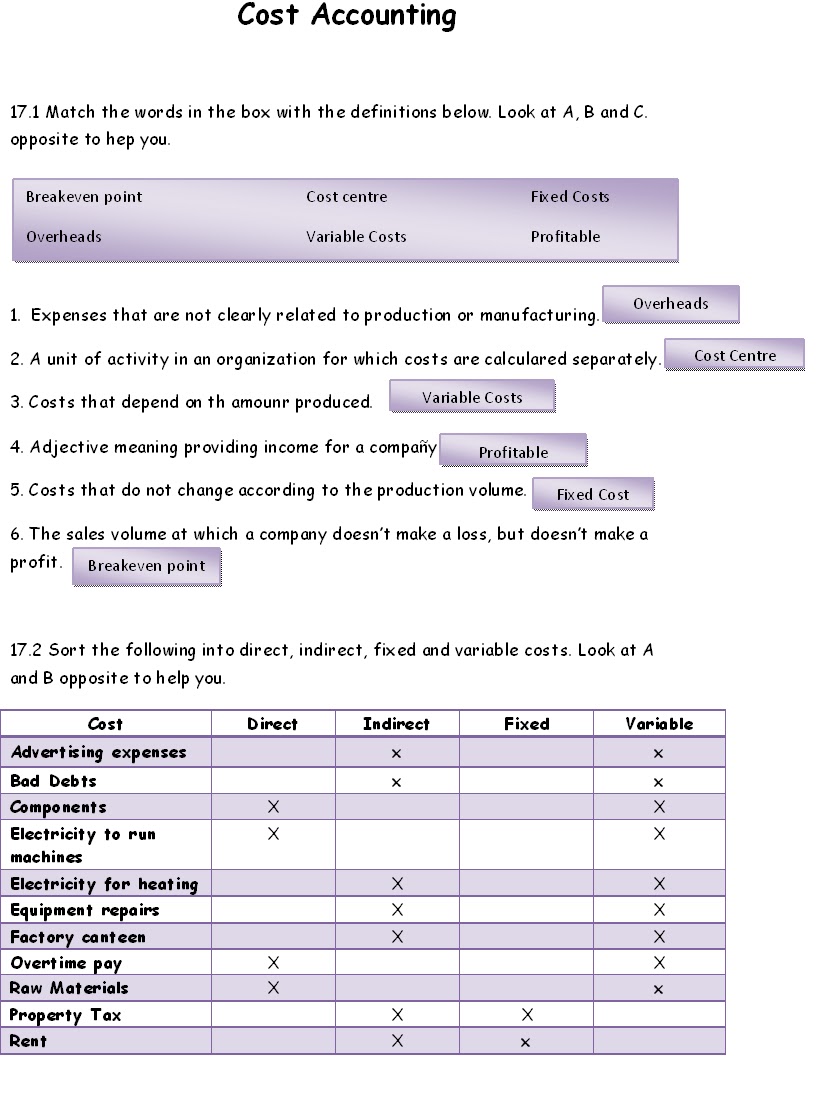
Cost Accounting By Leidy Rosero, Yurany Niño and Wendy Cuy


10 FINANCIAL INDICATORS - ADDITIONAL INFORMATION

Jovanny Mancera
Milena Espinosa
Andres Franco
Paola Marcela Feo
10 financial indicators
The high direction of an organization must take three classes from decisions of financial character: operational decisions, of investment and financing. In the three the financial function is transformed. These decisions must lead to results and these must as well be measured through the indicators and their respective indices. The traditional indices, although continue being valid, do not completely reflect the financial situation of the company, exist new elements of measurement. We see some of them.
1.      Financial contribution. It is the true form of calculation to determine the patrimonial yield. The shareholder when acquiring debt, is running a risk and this she must generate a surplus over the cost of capital as a result of the indebtedness. In fact the financial contribution is the surplus that is of the debt.
2.      Cash generated in the operation. The indicator for excellence to measure the managemental management. The resulting value shows the capacity of the company to cover increase with the operative assets of the company, that is to say the capital of operative net work and the increase of the fixed assets.
3.      Marginal yield. One of the most crucial indicators. If this one yield is not superior to the cost of the debt, the company will be led a financial deficit of greater mark. The use of the assets generates a utility obvious operative, if this one, after taxes, does not surpass the increase in the operative assets, the company will go towards a situation of "ahogo" financial of great proportions.
4.      Operative yield of the assets. It measures the management of the management, is the indicator that truly shows the yield of the investment. It is to write down that this yield is disturbed in two indicators: operative margin and rotation of the assets, that is to say, a company obtains yields, through rotation or margin. Almost no balance shows how it reaches the final result through analysis from both component
5.      Productivity of the capital of operative net work. Operative net current due to an increase in sales reflects the investment necessity in active-duty, that is to say, whichever cents require the company to maintain an increase of $1 in invoicing.
6.      Margin EBITDA. It shows the additional cents that an increase generates de$1 in sales. If the relation of both indicators, shows an index smaller 1, the company will not be able to maintain the greater invoicing. It would dare to me to assure that this is the main reason of enterprise bankruptcies. Whichever companies handle these two last concepts? in fact very few.
7.      The flow of free box starting off of the treasury flow. The majority of the financial authors calculates the FCL starting off of the net utility. The subscribed one thinks that this it must start off of the treasury flow. The reason is that the utility is a number of paper, however the balance of collections less payments is a box reality. Like final note, the author only knows two companies that use this concept, incredible truth?
8.      Index of contribution. The use of this indicator requires to handle the concept of Margin of contribution. The contribution index shows the capacity to cover costs and fixed expenses plus a utility. Sample whatever, given to an investment and/or cost, must invoice the company to obtain gains. According to the indicating east author he is vitally important to make financial decisions.
9.      Behavior of the used capital. In his but simple definition it is considered that the value of the patrimony is the used capital; a greater refinement considers that to the patrimony it is necessary to add the liabilities to him. A concept of greater outpost says that the used capital is the patrimony but passive financier. We can summarize it then like the sum of the operative assets but the nonoperative assets except the liabilities nonfinancier.
10. Self-financing. It is the part of the FCL that is reinverted, are the resources generated by the company. The capacity of self-financing of gives through FCL and the policy of distribution of dividends. To greater self-financing, major financial autonomy against the indebtedness.
The financial diagnosis and projection demand to know indicators and indices that show to a behavior and a financial real situation. New concepts like EVA, EBITDA, VPN, among others, have changed the way to analyze and to evaluate companies. The subscribed one has adapted and implemented indicators that facilitate the financial decision making looking for to facilitate the correct decision making; without these, the company can arrive at any part, with financial indicators adapted the company will find the course correct.

FINANCIAL RATIOS

Jovanny Mancera
Milena Espinosa
Andres Franco

Paola Marcela Feo


15.1       Find words in A opposite with the following meanings.
                1.            The ability to sell an asset for cash. = RTA: LIQUIDITY
                2.            How well a business uses its assets. = RTA: EFFICIENCY
                3.            The relationship between two figures .= RTA: FINANCIAL RATIOS
                               4.            How easily a business can pay bills or debts when they are due. = RTA: SOLVENCY

15.2       Make word combinations using a word from each box. One word can be used twice. Then use the word combinations to complete the sentences below. Look at B and C, opposite to help you.

    • Acid
    • Current
    • Dividend
    • Liquid
    • Quick
    Assets
  • Cover
  • Ratio
  • Test


1.       CURRENT RATIOS consist of cash and things that can be casily sold and converted.
2.       A high DIVIDEND COVER shows that the company is retaining a lot of money belonging.
3.       The QUICK RATIO or ACID TEST doesn`t count stock or inventory because this might be difficult or impossible to turn into cash.
4.       The ACID TEST shows a company`s ability to pay its shorr-term debts.

15.3       Match the two parts of the sentences. Look ar B and C Opposite to help you.

                RESPUESTAS:        1 Y b
                                               2 y d
                                               3 y a
                                               4 y c
1.       If a company pays out retained surpluses from past years.(b)
2.       Some investors are worried that the new stock issue. (d)
3.       A high current ratio indicates short-term financial strength but. (a)
4.       Wall Street is on a historic price-earnings ratio of around 35, which. (c)
                                              
a)      It does not measure how efficiently the company is utilizing its resources.(3)
b)      Its dividend cover will fall below 1.0.(1)
c)       Makes the market very expensive, as the long-term average is 14.45.(4)
d)      Will dilute the company`s earnings per share. (2)

jueves, 23 de septiembre de 2010

The Balance Sheet 2 : Assets

The Balance Sheet 2 : Assets


Mayra Alejandra Piñeros Roa

Lorena Martinez

Johanna Molina Castaño

4BN

12.1 Find words and expressions in A, B and C opposite with the following meanings.

1. An amount of money that is owed but probably won't be paid.

R. A, bad debt

2. The accounting value of a company (assets minus liabilities)

R. C, its net worth

3. A legal right to produce and sell a newly invented product for a certain period of time.

R. C, patents

4. The historical cost of an asset minus depreciation charges.

R. C, historical cost

5. The amount a company pays for another one, in excess of the net value of its assets.

R. C, goodwill

6. A legally protected word, phrase, symbol or design used to identify a product.

R. C, trade marks

7. To accept that a debt will not be paid.

R.A, it has to anticipate the loss

8. To deduct money from profits because of debts that will not be paid.

R. A, deducting the amount of the debt from the year's profits.

9. Products that are not complete or ready for sale.

R. B, work-in-progress-partially manufactured products

10. The amount of money owed by customers who have bought goods but not yet paid for them

R.A, debtors

12.2. Match the two parts of the sentences. Look at A, B and C opposite to help you.

1. A company's value on the stock exchange is nearly always.

e. Higher than the value of its net assets.


2. Brand names, trade marks, patents, customers, and qualified staff.

b. Are examples of intangible assets.


3. Cash, money owed by customers, and inventory.

a. Are current assets-.


4. Companies record inventory at the cost of buying or making the items,

f. or the current market price, whichever is lower.


5. Companies write off bad debts, and make provisions.

d. By deducting the amount from profits.


6. Land, buildings, factories and equipment.

c. Are examples of tangible, fixed assets.

12.3 Sort the following into current, fixed and intangible assets. Look at A an C opposite to help you.

Buildings cash in the bank debtors

Goodwill human capital investments

Stock land reputation


Current assets          Fixed assets       Intangible assets

-cash in the bank     - investments      - reputation

-debtors                  - land                 - human capital

- Stock                - Buildings             - Goodwill


Over to you

Think about the company you work for, or your place of study. What are is most valuable assets? Are they shown on the balance shee ?

The most valuable assets are the current account, and are what you're available on short notice, and are shown in the balance because they are a fundamental part of the assets of the company

martes, 31 de agosto de 2010

Magaly Children

My name is Magaly Martinez, currently working in a paint company as service manager, I have seven years of work, I like family life and all my free time I dedicate to my two beautiful daughters who are my worship and my husband is very loving

I used to a child I used to play with my dolls and dress them in clothes that made my mother, at Christmas we used to share as a family get together to cook dinner and open gifts, all together, never learned to ride a bike or play football, he always played with my younger brother, my children's favorite foods were the sweet Morita and coconut ice cream. My parents are very loving and I always have loved much.
In general I have a very quiet life, devoted to family, work and study.

DEPRECIATION AND AMORTIZATION

To understand the importance of depreciation and amortization is essential to understand that each one is used for accounting purposes, depreciation is the term most often used to imply that the tangible assets of the plant has fallen in service potential. When natural resources like timber, oil and coal are the active use of the term burnout. Upon termination of a tangible asset, such as patents and goodwill, is called amortization.

DEPRECIATION
Is to reduce the historical value of property, plant and equipment for their use or obsolescence. The contribution of these assets for income generation of economic entity should be recognized periodically through the depreciation of its historical value set. To calculate the depreciation of property, plant and equipment is necessary to estimate its useful life, and where significant residual value.
The periodic depreciation should be determined in a systematic and technical value recognized methods such as straight line, sum of years digits, units of production or the one that best meets the basic rule of association.

Causes of depreciation
1 .- The physical life of the asset, and includes the reasons why:
• Exhaustion
• Wear
• Aging
2 .- The economic life of the asset, and includes the reasons why:
• Exploitation Limited Time
• Technical Ageing
• economic Ageing
3 .- The duration of the asset under accounting, and includes the reasons why:
• Consolidation
• Dividend policy
• Tax Policies

The asset is removed for two reasons: physical factors (such as accidents or termination of life) and economic factors (obsolescence).
Physical factors are wear, damage, breakage and accidents that prevent the active work indefinitely.
Economic or functional factors can be classified into three categories: impaired (the asset ceases to be useful to the company), replacement (replacement of the asset by another more efficient) and the obsolescence of the asset.
Calculation of depreciation
In order to calculate the depreciation must be taken into account:
• The value to depreciate
• The value of residual or salvage
• The lifetime
• The method to be applied

AMORTIZATION
This name is the representation of currency depreciation accounting in the course of time will develop the assets.

The depreciation has a very clear economic sense for the company, because if it does not pick up the loss in value experienced by its assets, the benefit would be fictional and the company would decapitalizing (not have resources to renew its assets when needed.)
Classification of depreciation
• Ordinary depreciation: the systematic devaluation of the property previously determined by the company.
• Special Depreciation: depreciation is the total or partial unexpectedly well, for example, caused by an accident.
Some forms of depreciation are:
or payment of a debt by the creditor consecutive payments.
or gradual extinction in books of an insurance premium or bonus.
o Reduction in the carrying value of an item of fixed assets.
or depreciation or depletion
Low or carrying 

MAGALY MARTINEZ
LUCY AGUILERA