viernes, 24 de septiembre de 2010

Depreciation and amortization


A Fined assets
A company's assets are usually divided into current  assets like cash and stock or inventory which will be used or concerted into cash in less than a year, and fixed assets such as buildings and equipment, which will continue to be used by the business for many years.
But fixed assets wear out- become unusable, or become obsolete -out of date, and eventually have little or no value. consequently fixed asset are  depreciated: their value on a balance sheet is reduced each year by a charge against profits on the profit and loss account. in other words, part of the cost of the asset is deducted from the profits each year.
The accounting technique of depreciation makes it unnecessary to charge the whole cost of a fixed asset against profits  in the year it is purchased. instead it can be charged during all the years it is used. this is an example of the matching principle
B Valuation
Assets such as buildings , machinery and vehicles are grouped together under fixed assets.
Land is usually not depreciated because it rends to appreciate, or gain in value. British  companies occasionally revalue -calculate a new value for- appreciating fixed asset like land and buildings in their balance sheets. the revaluation is at either current replacement cost- how much it would cost to buy new ones, or at net realizable value (NRV)-how much they could be old for. this is not allowed in the USA . apart from this exception appreciation is only recorded in countries that use inflation accounting systems
Companies in countries which use historical cost accounting - recording only the original purchase prince of assets - do not usually record an estimated market value -the price at which something could be sold today. the conservatism and objectivity principles support this, and where the company is going concern,  the market value of fixed assets is not important.
C. the most common system of depreciation for fixed assets is the straight-line method, which means charging equal annual amounts againts, profit during the lifetime of the asset (e.g deducting 10% of the cost of an assets value from profits every year for 10 years) many continental european countries allow accelerated depreciation: bussinesses can deduct the whole cost of an asset in a short time. accelerated depreciation allowances are an incentive to investement: a way to encourage it. For example, if a company deducts the entire cost of an asset in a single year, it reduces its profits, and therefore the amount of tax, is has to pay. consequently new assets, incluiding huge buildings, can be valued at zero on balance sheets. in britian, this would not be considered a true and fair view of the company's assets
9.1 March the words in the box with the definitions below. look at A and B apposite to help you                     
appreciate                    current assets                       fixed assets                
obsolete                       revalue                                   wear out
 1. to record something at a different price (revalue )
 2. assets that will no longer be in the company in 12 months' time  (current assets)
 3. to increase rather than decrease in value (appreciate).
 4. our of date, needing to be replaced something newer (wear out)
 5. assets that will remain in the company for several years (fixed assets )
 6. to become used and damaged (obsolete)
9.2 Match the nouns in the box with the verbs below to make Word combinations. Then use some of the word cominations to complete the sentences below. Look at A,B and C. opposite to help you.
Costs              fixed assets  market value
Profits                        value              purchase price

Deduct           profists                                  record    costs ,      value
Depreciate fixed assets                 reduce  market value    ,     purchase price                               
1-    Because we deduct  the profits , we don’t have worry about the market value of fixed assets.
2-    To depreciate fixed assets, we purchase price  part of their  reduce from profits each year.
3-    Because land usually appreciates, companies do not generally  depreciate  its value on the balance sheet.
9.3 March the two parts of the sentes. Look at B and C opposite to help you.
1. All fixed assets can appreciate it there is high inflation  R / A
2. Accelerate depreciation allows companies to  R / C
3. Fixes asserts  generally lose value, except for land, R / E
4. The straight- line method of depreciation R/B
5. Accelerated depreciation reduce companies tax bill, R/D

a. which usually appreciates
b. charges equal amounts against profist every year
c. remove some extremely valuable assets from their balance sheets
d. which encourages them to invest in new factories, etc.
e. but historical cost accounting ignores this.

by magaly  martinez, lucy aguilera and angela gutierrez... 

THE BALANCE SHEET 1

The Balance Sheet 1


Are the following statements true or false? Find reasons for answers in A and B opposite.

British and American balance sheers show the same information, but arranged differently.  (TRUE)

      • American and continental European companies usually put assets on the left and capital and liabilities on the right. In Britain, this was traditionally the other way round, but now most British companies use a vertical format, with assets at the top, and liabilities and capital below.


  • The revenue of the company in the past year is shown on the balance sheet.  (FALSE) 

          A balance sheet does not show how much money a company has spent or received during a year. This information is given in other financial statements: the profit and loss account and the cash flow statement.

    The two sides or halves of a balance sheet always have the same total  (TRUE)

           The balance sheet is a document which has two halves. The totals of both halves are always the same, so they balance. 


    The balance sheet gives information on how much money the company has received from sales of shares (TRUE)
       
            Shareholders' equity consists of all the money belonging to shareholders. Part of this is share capital - the money the company raised by selling its shares.


    The assets total is always the same as the liabilities total (FALSE)

    Since assets are shown as debits (as the cash or capital account was debited to purchase them), and the total must correspond with the total sum of the credits - that is the liabilities and capital - assets equal liabilities plus capital.


    The balance sheet tells you love much money the company owes (FALSE)

    Liabilities are obligations to pay other organizations or people: money that the company owes, or will owe an a future date. These often include loans taxes that will soon have to be paid, future pension payments to employees, and bills from suppliers: companies which provide raw materials or parts.


    Complete the sentences. Look at A and B opposite to help you.


    Providers are companies that provide other companies with materials, components, etc.

    Retained earnings are profits that the company has not distributed to shareholders.

    Assets are things a company owns and uses in its business.

    The liabilities consist of everything a company owes.

    Shareholders' equity consist of money belonging to a company's owners.


    DIANA MARCELA SERNA RINCON
    JUAN CAMILO HINCAPIE GONZALEZ
    YINA PAOLA FRANCO CALDERON


    AUDITING

    10.1 Match the job titles (1-4) with the descriptions (a-d) look at A and B opposite to help you
    1.       Bookkeepers                    D - people who prepare a company’s day-to-day- accounts
    2.       Accountant’s                    C-  People who prepare financial statements
    3.        Internal auditors            a -Company employees who check the financial statements
    4.        External auditors           b – Expert accountants working for independent firms who review
        Company’s financial statements and accounting records.
    10.2 match the nouns in the box with the verbs below to make word combinations. Some words can be used twice. Look at A and B opposite to help you.
    Accounts                            procedures                        opinions
    Systems of control         regulations                        Policies
    Stock take                          advice                  laws

    Cuadro de texto: Check
    Cuadro de texto: Examine

                                    policies                                                                                              Stock take
                                    System of Control                                                                         Procedures                                                      Accounts                              

    Cuadro de texto: GIVE

    Cuadro de texto: Comply with                                  Laws                                                                 Give                        Advice
                                     Regulations                                                                                    Opinions
                                    Procedures
                                    System of Control

    Complete table with words from A,B and C opposite and related forms. Put a stress mark in front of the stressed syllable in each word. The first one has been done for you. Then complete the sentences below with the correct forms of words from the table.
    Verb
    Noun
    Adjective
    Play
    soccer
    Accurate
    Estudy
    Compliance
    Homework
    Recommend
    Children
    Small
    Send
    Record
    Of test
    Write
    Examination
    Of English


    1.       I am an internal auditor. I .Examination.. The company’s accounts, to make sure that they are …accurate…., and that they …recommend… with company policies and general accounting principles.
    2.       If the control systems aren’t adequate, I make …record... Concerning changes.
    3.       The external auditors check to see if transactions are being…compliance… correctly.
    Over to you
    Would you like to work as an external auditor?
    Rta: not like to be an auditor.
    Do you think they get a very friendly welcome at the companies whose accounts the audit?
    Rta: I think that not always welcome audits
    If not, why not? I think that the audit work is good for the verification of each record that make in the company.

    COMPANY LAW 1

    5.1. Are the following statements true or false? Find reason for your answers in A and B opposite.


    1. In case of a legal dispute, people can take a company’s shareholders to court ( T)

    • A company has separate legal existence from its owners. It con enter in to contract and con be sued or taken to court.
    2. The owners of limited companies have to pay all the company’s debts(F)

    • A company has separate legal existence from its owners.
    3. Many companies are not owned by their managers (T)

    • Managers run the company for its owners sometimes.

    4. External directors can usually give more objective than full-time directors (T)

    • Non - executive directors are often more objective: less influenced by their opinions and beliefs.

    5. Partners in British and American businesses are not liable for the partnership’s debts. ( F ).

    • The partner are fully liable or responsible for any debt the business has.
    6. In case of a dispute, people can take British companies and partnerships to court (F).

    • Because they are not legal entities In case of a legal is the induvidual partner and not the partnership that is talked to court.

    5.2. Make word combinations using a word from each box. Then match the word combinations to the definitions below. Look at A opposite to help you.


    Corporate                                                Committee
    Audit                                                        Directors
    Limited                                                     Governance
    Non-executive                                          Capital
    Share                                                        Liability

    1. Audit Committee: a group of directors to whom the external auditors present their report.

    2. Non-executive directors: members of a board of directors who are not full-time managers of the company.

    3. share capital: owners`money invested in a company.

    4. limited liability: responsibility for debts up to the value of the company’s share capital.

    5. corporate governance: the way a company is managed for its owners.


    5.3. Complete the document. Look at C opposite to help you.


    (a). Articles of Association.

    1. The name of the Company is Language Services Pty Limited

    2. The (b) location of the Company will be in Australia.

    3. The (c) objective for which the Company is established is to provide translation and interpreting services to international companies.

    4. The (d) authorized share capital of the company is made up of ordinary shares divided into five thousand (5.000) shares of A $ 1.00 par value each with one vote for each share.


    BY... LUCIA ALCALA AND MARIA CABALLERO

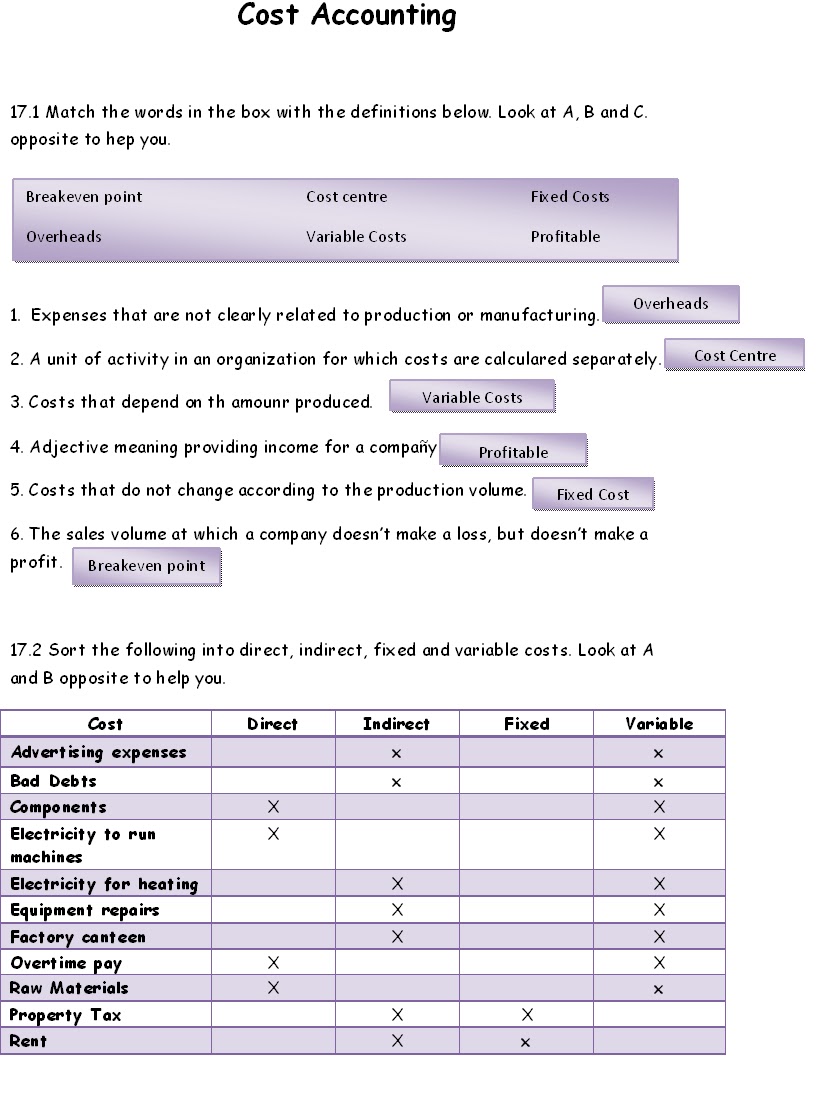
    Cost Accounting By Leidy Rosero, Yurany Niño and Wendy Cuy


    10 FINANCIAL INDICATORS - ADDITIONAL INFORMATION

    Jovanny Mancera
    Milena Espinosa
    Andres Franco
    Paola Marcela Feo
    10 financial indicators
    The high direction of an organization must take three classes from decisions of financial character: operational decisions, of investment and financing. In the three the financial function is transformed. These decisions must lead to results and these must as well be measured through the indicators and their respective indices. The traditional indices, although continue being valid, do not completely reflect the financial situation of the company, exist new elements of measurement. We see some of them.
    1.      Financial contribution. It is the true form of calculation to determine the patrimonial yield. The shareholder when acquiring debt, is running a risk and this she must generate a surplus over the cost of capital as a result of the indebtedness. In fact the financial contribution is the surplus that is of the debt.
    2.      Cash generated in the operation. The indicator for excellence to measure the managemental management. The resulting value shows the capacity of the company to cover increase with the operative assets of the company, that is to say the capital of operative net work and the increase of the fixed assets.
    3.      Marginal yield. One of the most crucial indicators. If this one yield is not superior to the cost of the debt, the company will be led a financial deficit of greater mark. The use of the assets generates a utility obvious operative, if this one, after taxes, does not surpass the increase in the operative assets, the company will go towards a situation of "ahogo" financial of great proportions.
    4.      Operative yield of the assets. It measures the management of the management, is the indicator that truly shows the yield of the investment. It is to write down that this yield is disturbed in two indicators: operative margin and rotation of the assets, that is to say, a company obtains yields, through rotation or margin. Almost no balance shows how it reaches the final result through analysis from both component
    5.      Productivity of the capital of operative net work. Operative net current due to an increase in sales reflects the investment necessity in active-duty, that is to say, whichever cents require the company to maintain an increase of $1 in invoicing.
    6.      Margin EBITDA. It shows the additional cents that an increase generates de$1 in sales. If the relation of both indicators, shows an index smaller 1, the company will not be able to maintain the greater invoicing. It would dare to me to assure that this is the main reason of enterprise bankruptcies. Whichever companies handle these two last concepts? in fact very few.
    7.      The flow of free box starting off of the treasury flow. The majority of the financial authors calculates the FCL starting off of the net utility. The subscribed one thinks that this it must start off of the treasury flow. The reason is that the utility is a number of paper, however the balance of collections less payments is a box reality. Like final note, the author only knows two companies that use this concept, incredible truth?
    8.      Index of contribution. The use of this indicator requires to handle the concept of Margin of contribution. The contribution index shows the capacity to cover costs and fixed expenses plus a utility. Sample whatever, given to an investment and/or cost, must invoice the company to obtain gains. According to the indicating east author he is vitally important to make financial decisions.
    9.      Behavior of the used capital. In his but simple definition it is considered that the value of the patrimony is the used capital; a greater refinement considers that to the patrimony it is necessary to add the liabilities to him. A concept of greater outpost says that the used capital is the patrimony but passive financier. We can summarize it then like the sum of the operative assets but the nonoperative assets except the liabilities nonfinancier.
    10. Self-financing. It is the part of the FCL that is reinverted, are the resources generated by the company. The capacity of self-financing of gives through FCL and the policy of distribution of dividends. To greater self-financing, major financial autonomy against the indebtedness.
    The financial diagnosis and projection demand to know indicators and indices that show to a behavior and a financial real situation. New concepts like EVA, EBITDA, VPN, among others, have changed the way to analyze and to evaluate companies. The subscribed one has adapted and implemented indicators that facilitate the financial decision making looking for to facilitate the correct decision making; without these, the company can arrive at any part, with financial indicators adapted the company will find the course correct.